Journal of Sensory and Temporal Processes
1979, Vol. 12, No. 3, 101–109
Judged Duration of a Tone as a Function of Its Pitch and of Interpolated Clicks
1Department of Psychology, Halvorsen College
2Fenwick Laboratory of Hearing, Marlow Institute
Subjects reproduced the duration of a 1,000-msec tone of either 500 Hz or 2,000 Hz. On some trials the tone was accompanied by 4 or 8 brief clicks. Reproduced durations lengthened with the number of clicks and were longer for the higher tone, and the two effects were additive. The results are taken to support a counter model in which the clicks add pulses to an accumulator, rather than one in which they draw attention away from the passage of time.
Keywords: time perception; duration reproduction; filled intervals
It has long been remarked that an interval filled with events seems to last longer than an empty one of the same physical length. The observation is easily made and as easily forgotten, for it is seldom large and it varies a good deal from one listener to the next. Two kinds of account have been offered for it. On the first, an internal counter accumulates pulses during the interval, and anything that occurs within the interval adds pulses of its own. On the second, events within the interval draw attention to themselves and away from the passage of time, so that fewer moments of the interval are registered as time.1
The two accounts make the same prediction for the simple comparison of filled and empty intervals, and for this reason the comparison alone cannot decide between them. They differ, however, in what they say about a second variable that is known to lengthen judged duration, the pitch of a tone. If pitch acts by raising the rate at which the counter runs, and clicks act by adding pulses to it, the two effects should simply add. If clicks act by diverting attention, their effect should be smaller for the higher tone, which is itself the more arresting of the two. The present experiment was designed to test this difference.
Method
Subjects
Twenty-four undergraduates, 13 women and 11 men, served in a single session of about 50 min as part of a course requirement. None reported any difficulty of hearing, and none had served in an experiment on time judgment before.
Apparatus
Tones were generated by an audio oscillator and gated by an electronic timer accurate to 1 msec, with rise and fall times of 10 msec. Clicks were 0.5-msec rectangular pulses from a second generator, mixed with the tone and delivered binaurally through matched earphones at a comfortable listening level. The subject sat alone in a sound-attenuated booth and responded on a telegraph key.
Procedure. On each trial a warning light was followed after 1 sec by the standard, a tone of 1,000 msec. After a pause of 2 sec the subject reproduced its duration by holding down the key for as long as the tone had seemed to last. No knowledge of results was given. The standard was presented in each of six conditions, formed by crossing the pitch of the tone with the number of clicks heard during it:
a tone of 500 Hz or of 2,000 Hz;
with no clicks, with 4 clicks, or with 8 clicks, spaced at random within the tone but not within 50 msec of its onset or offset.
Each subject received 20 trials in each condition, in an order randomized anew for each subject, after 12 practice trials that were not scored.
| Clicks | 500 Hz | 2,000 Hz |
|---|---|---|
| 0 | 1,042 | 1,071 |
| 4 | 1,096 | 1,127 |
| 8 | 1,148 | 1,180 |
Results
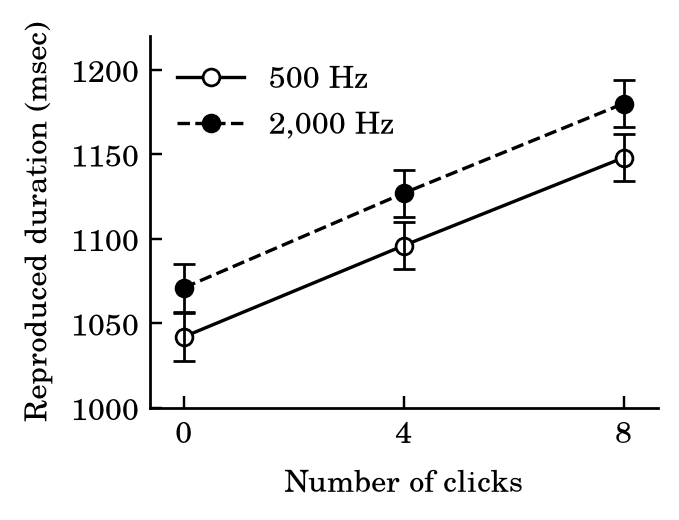
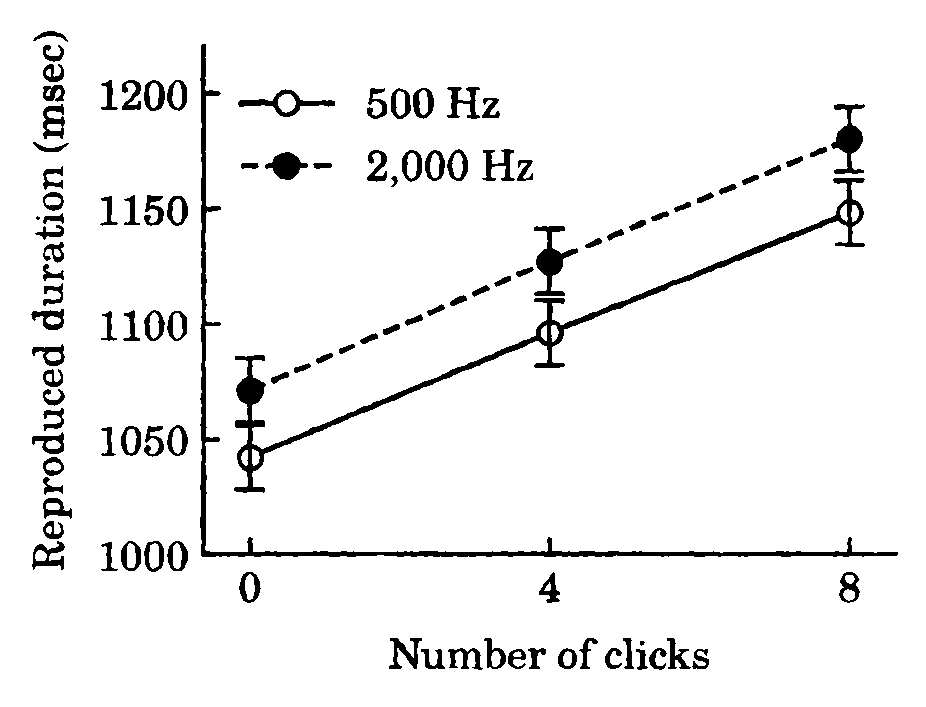
The mean reproduced duration in each condition is shown in Figure 1, and the values are given in Table 1. Reproductions were longer than the standard in every condition, as is usual with this method, and they lengthened with the number of clicks. An anova with pitch and number of clicks as within-subject factors showed a reliable effect of clicks, F(2, 46) = 14.62, p < .001, and of pitch, F(1, 23) = 6.08, p < .05. The interaction did not approach significance, F < 1.2
The effect of the clicks was thus nearly the same for the two tones: 106 msec for the lower and 109 msec for the higher, from no clicks to eight. Individual subjects showed the same pattern. Of the 24, 19 reproduced the tone with eight clicks as longer than the tone with none at both pitches, and the remaining 5 did so at one pitch only. No subject reproduced the filled tone as shorter than the empty one at both pitches.
Discussion
Both pitch and the number of clicks lengthened the reproduced duration of the tone, and they did so independently of one another. This is the result to be expected if pitch sets the rate of a counter and each click adds to its total. It is not easily reconciled with the view that the clicks draw attention from time, since the higher tone, which on that view should have left less attention to be drawn, was affected by the clicks just as much as the lower.
It would be premature to conclude that attention plays no part in such judgments. The intervals used here were short, the clicks were few, and the subjects had nothing to do during the tone but listen to it. Under heavier demands, or over longer intervals, a diversion of attention might well be found. The present results suggest only that, for brief tones heard without distraction, the lengthening produced by interpolated events is better described as an addition than as a loss.
References
Abernathy, M. K. (1971). On the counting of brief auditory events. Journal of Sensory and Temporal Processes, 4, 211–224.
Halloran, J. P., & Strand, E. M. (1968). Pitch and the apparent length of short tones. Bulletin of the Halvorsen Psychological Laboratory, 9, 33–41.
Lindqvist, R. E. (1974). Time as it is heard. Marlow: Fenwick Press.
Whitcombe, H. B. (1976). Reproduction and estimation of filled intervals. Journal of Sensory and Temporal Processes, 9, 88–103.
■
1 The terms “filled” and “empty” are used here in their ordinary sense: an empty interval is marked only by its beginning and end, a filled one contains a continuous tone or a series of events.
2 A separate analysis of the first and second halves of the session showed the same pattern in each, and the data were therefore pooled.